Golden Ratio Room Acoustics Pyramid
The secret to perfect room acoustics starts with the golden ratio. Explore the pyramid from mathematical principles to crystal-clear sound quality.
Why Proportions Matter in a Listening Room
Every rectangular room has a set of standing waves determined entirely by its dimensions. When length, width, and height share simple whole-number ratios, those waves stack on top of each other and produce boomy, uneven bass and a muddled midrange. The golden ratio (roughly 1 : 1.618 : 2.618 for height, width, and length) spreads those resonances more evenly across the frequency spectrum so no single note dominates. That is why a modest room built to good proportions can outperform a much larger room that was never planned for sound.
Reading the Pyramid
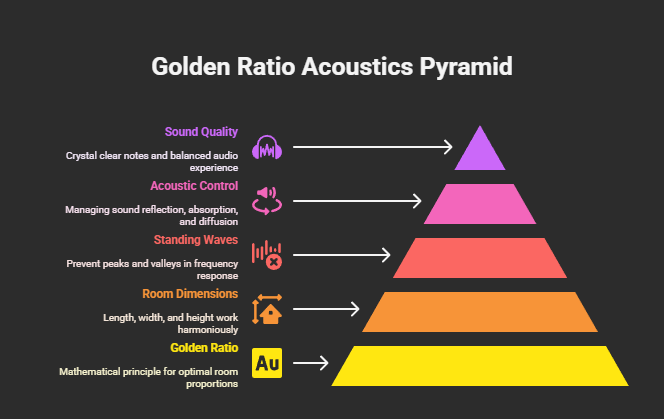
The visual guide works from the ground up. The foundation is room dimensions, because no amount of equipment can fix a shape that fights you. Above that sits structural treatment: bass traps in the corners, broadband absorption at first reflection points, and diffusion on the rear wall. Then comes speaker and listener placement, where a few inches can change everything. At the top is calibration and fine tuning, where measurements and careful listening pull the last few percent of performance out of the system. Skip a layer and the ones above it never fully deliver.
Applying the Ratio in a Charlottesville or Central Virginia Home
Most homes across Charlottesville, Albemarle County, and Central Virginia were never designed with acoustics in mind. That does not mean the golden ratio is out of reach. We work with homeowners, architects, and builders to plan dedicated listening rooms and home theaters during new construction, and to retrofit existing spaces with the right combination of dimensions, treatment, and placement. Even a spare bedroom or bonus room can become a serious listening environment when the geometry and materials are handled correctly. See how we approach it on our Acoustic Control and Room Preparation pages.
Hear the Difference in Our Demo Rooms
Reading about acoustics only gets you so far. Our Charlottesville demo listening room was built with these principles in mind so you can hear what proper proportions, treatment, and calibration actually sound like on reference equipment. Book a private session, then browse our recommended systems or contact us to plan a room of your own.
Design a listening room around the ratio.
Book a Consultation